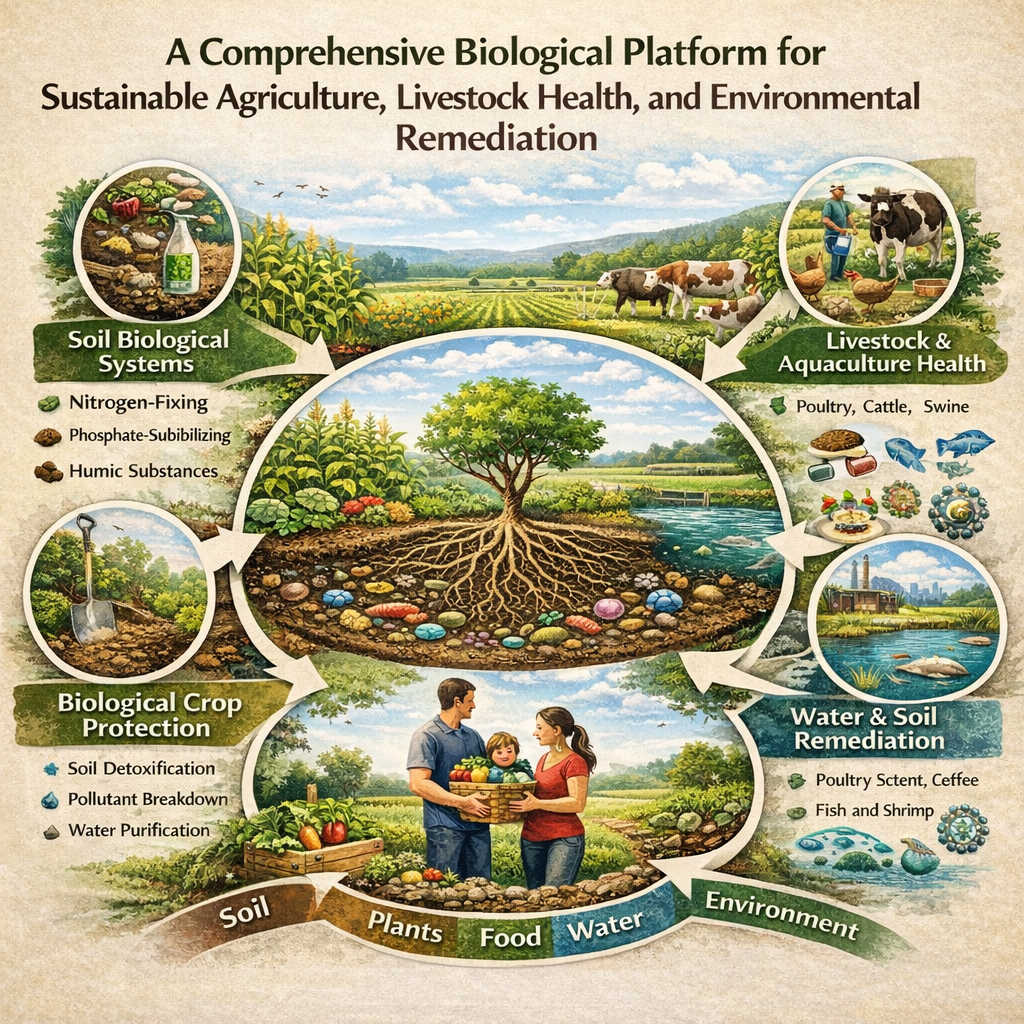
Modern agricultural systems face escalating challenges including soil degradation, salinity, declining nutrient-use efficiency, pest resistance, and environmental contamination from synthetic agrochemicals. This white paper presents a comprehensive biological platform integrating beneficial microorganisms, organic nutrient systems, plant biostimulants, nano-enabled delivery technologies, and probiotic-based livestock and aquaculture solutions. The system is designed to restore soil functionality, enhance plant metabolic efficiency, improve crop quality, and remediate contaminated environments while supporting animal and human health.
Through mechanisms such as biological nutrient cycling, induced systemic resistance, microbial competition, enzymatic degradation, and rhizosphere optimization, this platform demonstrates the capacity to deliver high yields at reduced input cost, while improving soil structure, reducing salinity, and increasing resilience to abiotic and biotic stresses. The integration of crop, soil, water, and animal systems establishes a closed-loop biological model aligned with ecological processes. This paper evaluates the scientific basis, mechanisms of action, agronomic impact, and scalability of this system, with particular relevance to emerging agricultural markets such as India.
1. Introduction
Global agriculture is undergoing a critical transition driven by the need to:
-
Increase productivity to meet growing food demand
-
Reduce environmental impact
-
Restore degraded soils
-
Improve food quality and safety
Conventional farming systems have relied heavily on synthetic fertilizers and pesticides, leading to:
-
Soil organic matter depletion
-
Nutrient imbalances
-
Reduced microbial diversity
-
Increased pest and disease resistance
-
Accumulation of chemical residues
These factors collectively reduce long-term productivity and sustainability.
Biological agriculture offers an alternative paradigm, leveraging natural biological processes to restore soil fertility, improve crop performance, and enhance ecosystem resilience. The platform described in this paper integrates multiple biological domains into a unified system, addressing the entire agricultural value chain.
2. System Architecture and Integration
The platform is composed of five interconnected components:
2.1 Soil Biological Systems
-
-
Nitrogen-fixing bacteria
-
Phosphate-solubilizing microorganisms
-
Potassium-mobilizing bacteria
-
Mycorrhizal fungi
-
2.2 Plant Biostimulation and Regulation
-
-
Organic compounds influencing plant hormone pathways
-
Amino acids, seaweed extracts, and bioactive metabolites
-
2.3 Biological Crop Protection
-
-
Microbial antagonists of plant pathogens
-
Botanical compounds with pesticidal properties
-
2.4 Nano-Enabled Delivery Systems
-
-
Nanostructured carriers improving nutrient uptake efficiency
-
2.5 Livestock and Aquaculture Probiotics
-
-
Beneficial microbial consortia for gut health and feed efficiency
-
These components operate synergistically to optimize biological function across soil, plant, and animal systems.
3. Mechanisms of Action
3.1 Nutrient Cycling and Bioavailability
Biological nitrogen fixation converts atmospheric nitrogen into plant-available forms, reducing dependency on synthetic nitrogen fertilizers. Phosphate-solubilizing microorganisms release organic acids that mobilize insoluble phosphorus, while potassium-mobilizing bacteria enhance potassium availability.
3.2 Rhizosphere Optimization
The rhizosphere represents a dynamic interface between plant roots and soil microbiota. Beneficial microbes enhance root architecture, increase surface area, and improve nutrient absorption through:
-
-
Root exudate signaling
-
Symbiotic associations (e.g., mycorrhizae)
-
Rhizophagy cycle processes
-
3.3 Plant Growth Regulation
Biostimulant compounds influence plant hormone balance, including:
-
-
Auxins (root development)
-
Cytokinins (cell division)
-
Gibberellins (growth elongation)
-
These processes improve biomass accumulation and developmental efficiency.
3.4 Photosynthesis and Chlorophyll Enhancement
Enhanced nutrient uptake and metabolic activity increase chlorophyll synthesis and photosynthetic capacity, leading to:
-
-
Higher energy production
-
Increased carbohydrate synthesis
-
Improved yield potential
-
3.5 Crop Quality Enhancement
Biological stimulation of plant metabolism results in:
-
-
Increased soluble solids (Brix)
-
Enhanced terpene and essential oil production
-
Improved flavor, aroma, and nutritional density
-
Extended post-harvest shelf life
-
3.6 Disease Suppression
Disease control is achieved through multiple biological pathways:
-
-
Competitive exclusion: Beneficial microbes occupy ecological niches
-
Antibiosis: Production of antimicrobial compounds
-
Induced systemic resistance (ISR): Activation of plant immune responses
-
Enzymatic degradation: Breakdown of pathogen cell walls
-
3.7 Pest Control Mechanisms
Biological pest control involves:
-
-
Entomopathogenic microbial infection
-
Feeding inhibition
-
Disruption of insect development
-
Repellency through plant-derived compounds
-
3.8 Environmental Remediation
Microbial consortia facilitate:
-
-
Degradation of herbicides and pesticides
-
Reduction of organic pollutants
-
Immobilization of heavy metals
-
Restoration of soil microbial diversity
-
Water systems benefit from improved microbial balance, reducing ammonia, nitrites, and organic load.
4. Topsoil Regeneration
Topsoil regeneration is fundamental to long-term agricultural productivity.
4.1 Organic Matter Accumulation
Increased organic carbon enhances soil fertility, nutrient retention, and microbial activity.
4.2 Soil Structure Improvement
Microbial exopolysaccharides promote aggregation, improving porosity, aeration, and root penetration.
4.3 Salinity Mitigation
Biological processes reduce sodium toxicity and improve ion exchange balance.
4.4 Water Retention
Enhanced soil structure increases water-holding capacity and drought resilience.
5. Crop Disease and Pest Spectrum
5.1 Major Crop Diseases
Rice: blast, bacterial blight, sheath blight
Vegetables: powdery mildew, fusarium wilt, damping-off
Fruit trees: anthracnose, root rot, leaf spot
Corn: leaf blight, rust, smut
Vegetables: powdery mildew, fusarium wilt, damping-off
Fruit trees: anthracnose, root rot, leaf spot
Corn: leaf blight, rust, smut
5.2 Major Pest Groups
Rice: stem borers, planthoppers, stink bugs
Vegetables: aphids, whiteflies, thrips, caterpillars
Fruit trees: fruit flies, psyllids, scale insects
Corn: armyworms, borers, rootworms
Vegetables: aphids, whiteflies, thrips, caterpillars
Fruit trees: fruit flies, psyllids, scale insects
Corn: armyworms, borers, rootworms
6. Livestock and Aquaculture Integration
Probiotic systems enhance:
-
-
Gut microbiome balance
-
Nutrient absorption
-
Feed conversion efficiency
-
Immune function
-
Applications include poultry, swine, cattle, and aquaculture species, contributing to reduced antibiotic use and improved production efficiency.
7. Economic and Agronomic Impact
The platform supports a low-cost, high-yield model:
-
Reduced chemical input costs
-
Increased yield and crop quality
-
Improved soil longevity
-
Enhanced resilience to environmental stress
This model is particularly relevant for developing agricultural economies.
8. Relevance to India
India presents significant opportunities for biological agriculture due to:
-
Soil degradation and salinity challenges
-
Government support for sustainable farming
-
High demand for organic and residue-free produce
The described system aligns with national priorities for:
-
Sustainable intensification
-
Soil health restoration
-
Farmer income improvement
9. Discussion
The integration of biological systems across soil, plant, animal, and water domains represents a paradigm shift in agriculture. Unlike single-input solutions, this platform provides a holistic, systems-based approach.
Challenges include:
-
Farmer education and adoption
-
Standardization of biological inputs
-
Regional customization
However, the long-term benefits in productivity, sustainability, and environmental health outweigh these barriers.
10. Conclusion
This white paper demonstrates that a comprehensive biological platform can effectively replace or significantly reduce reliance on synthetic agricultural inputs. By restoring natural processes, enhancing biological interactions, and integrating multiple agricultural domains, this system delivers:
-
Higher yields
-
Improved crop quality
-
Enhanced soil health
-
Reduced environmental impact
-
Better animal and human health outcomes
Agriculture, when aligned with biological systems, functions as a regenerative cycle—efficient, resilient, and sustainable—reflecting the way nature was meant to operate.